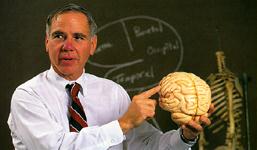
Thomas B. Perera Ph.D.
Click BACK to Return to Dr. Perera's homepage:
Click BACK to Return to Dr. Perera's homepage:
Internet ENIGMA Museum:
COPYRIGHT NOTICE: (Copyright (c) 2023: Prof. Tom Perera Ph. D.)
Professor Emeritus of Psychology
Montclair State University
PHYSIOLOGICAL PSYCHOLOGY / BEHAVIORAL NEUROSCIENCE SYLLABUS:
PHYSIOLOGICAL PSYCHOLOGY / BEHAVIORAL NEUROSCIENCE                  Dr. Perera

DESCRIPTION:  An introduction to the structure (ANATOMY), function
(PHYSIOLOGY), and dysfunction (PATHOLOGY) of the human nervous system.
Beginning with a detailed consideration of the nerve cell, the course proceeds
through the entire peripheral nervous system including the sense organs and
muscles.  The central nervous system is then studied in detail from the spinal
cord through the brain.  Finally, the involuntary (autonomic) nervous system,
sleep, eating, memory, sexual behavior, biofeedback, and higher mental
functioning are discussed.

Notes: Perera,T.B. Visualized Lecture Notes for Physiological Psychology. MSU.
OPTIONAL:
Texts: Noback,C.R.,Strominger,N.L., & Demarest,R.J. (1996). The human nervous
            System. Philadelphia: Lea & Febiger. (5th Edition)
or     Noback, C.R. et. al., The Human Nervous System, (4th Edition)
Ref:   Netter, F. H. (1958). The Nervous System. (Vol 1). Summit,NJ: Ciba

                                                   NETTER   NOBACK91  NOBACK96
Lecture                     Topic                  Plates    Pages     Pages
-------------------------------------------------------------------------------

1   Introduction to Physiological Psychology                    1-4    vii-xi
2   The Nerve Cell (Anatomy)                                   15-25    11-27
3   Nerve Cell Degeneration & Regeneration                     26-31    27-30
4   Nerve Cell Electrophysiology                               33-56    31-57
5   EXAM:  The Receptors: Skin & Chemical Receptors           115-157  113-153
6   The Ear:  (Anatomy)                                       251-255  229-237
7   The Ear:  (Physiology)                                    255-268  237-242
8   The Eye:  (Anatomy)                                       297-302  263-269
9   The Eye:  (Physiology)                                    302-317  269-278
10  The Effectors (Muscles)                                   115-127  113-122
11  The Central Nervous System:  Meninges       (11-16,21,23)  67-69    67-82
12  The Spinal Cord:  (Anatomy)                 (1-10,26-32)  103-113  103-111
13  The Spinal Cord:  (Physiology)                (26-32)     115-127  123-137
14  The Spinal Cord:  (Afferent Pathways)                     129-157  139-153
15  The Spinal Cord:  (Efferent Pathways)                     159-174  155-167
16  The Spinal Cord:  (Lesions & Pathology)       (73-104)    175-189  169-179
17  Examination                                                        203-215
18  The Brain: Cranial Nerves, Brain Development              219-237   83-102
                                                               83-102   59-65
19  The Brain: Ventricles & Cerebrospinal Fluid  (11-19,21-32  57-81    67-82
20  The Brain: General Anatomy & Physiology      (17-23)        5-15     1-9
21  The Cerebellum                               (45-46)      281-296  251-262
22  The Thalamus                           (18,19,22,23,25,47 361-373  317-328
23  The Brain:  (Layers of the Cortex)            (48)        397-424  347-368
24  The Autonomic Nervous System:                 (53-72)     319-332  279-290
        The Brainstem:                                        191-217  181-201
25  The Hypothalamus:  (Anatomy & Physiology)     (Supp 1-18) 333-348  291-297
26  Stereotaxic Surgical Procedures               (Supp 1-18) 349-360  297-304
27  Higher Functions:  (Sleep, Sexual Behavior, Timing, etc.) 375-395  305-315
28  The Neurological Examination:  (Clinical Procedures)      269-279  329-346
        Neurotransmitters:                                    238-249  217-228
29  Review for Comprehensive Final Examination                         243-250
                                                  (Note: Some readings overlap)
-------------------------------------------------------------------------------
There will be two hour examinations and a cumulative final examination.

Brain Model:  You will construct a 3 dimensional paper and cardboard model of
              the human brain from a kit included in the lecture note pack.

Term Paper:  (OPTIONAL) A short (5-7 pages double-spaced) paper that critically
             and carefully analyzes any topic, research, or disease involving
             the structure, function, or pathology of the nervous system.

ON-TIME ATTENDANCE is REQUIRED at all class sessions.
CONTACT INFORMATION
Please Note: IF YOU DO NOT RECEIVE AN ANSWER TO YOUR EMAIL
IT MEANS THAT I CAN NO LONGER RESPOND.
Please use internet search engines to find other information if you do not receive a reply.
Professor Emeritus:
Montclair State University
Internet On-Line Telegraph & Scientific Instrument Museums:
I ask you to type my email address as
follows with no spaces between words:)
Please use internet search engines to find other information if you do not receive a reply.
IF you do not receive a reply my spam cleaner might have intercepted your
email.
Pease try again with a different Subject and Text.
http://w1tp.com
https://EnigmaMuseum.com
Although all the pictures and text are copyrighted, you may use any of them
for your own personal applications including public lectures and
demonstrations, publications and websites as long as you mention the
w1tp.com Museum. If you plan to offer them for sale to the public
in any form, please email me for permission which I will generally grant as
long as you mention my museum: http://w1tp.com or https://EnigmaMuseum.com My email address is
given at the bottom of this page. Some of the material may require contacting
other copyright owners for commercial use and I will inform you by email.
Please also see the Disclaimer of Warranty.